
In brief: Every connected device needs a way to store power, and for the smallest, thinnest applications, most conventional batteries simply don't fit. Ligna Energy, a Swedish cleantech company founded in 2017, builds ultra-thin, sustainable batteries and supercapacitors designed specifically for the Internet of Things, devices like smart cards, sensors, and asset trackers. Backed by more than a decade of roll-to-roll manufacturing expertise and a patent strategy built with Lightbringer, the company is proving that sustainable energy storage and fast IP protection can scale together.
Let's meet the founders of the future
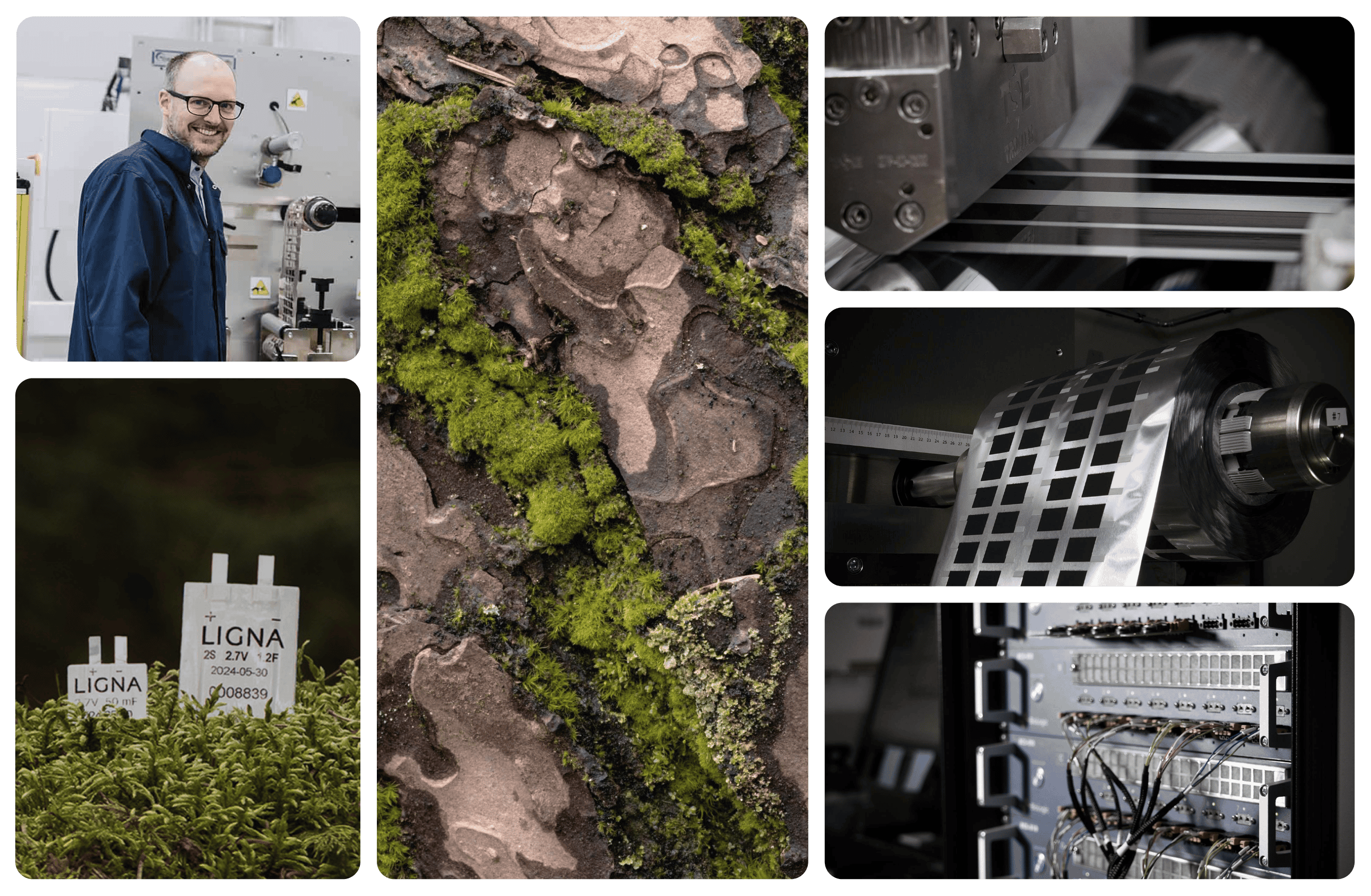
In this customer success story, we meet Jakob Backe, CTO of Ligna Energy, a company reimagining how the world powers its smallest devices. Jakob joined seven years ago as the company's second employee, and has helped guide Ligna Energy through a shift from grid-scale ambitions to a manufacturing process built specifically for the Internet of Things, one that's thin enough, sustainable enough, and fast enough to scale.
From grid-scale ambitions to a pivot that stuck
Ligna Energy, founded in 2017, emerged from a collaboration with Linköping University. As the university focused on material research for energy storage, specifically lignin, a natural polymer byproduct from wood generated by the pulp and paper industry. Ligna Energy developed the corresponding manufacturing technology. “The university had already been working with lignin for a couple of years,” Jakob says. “Our ambition at the start was to use this battery technology and put it into an actual battery cell.”
The original plan was to apply the technology to create large cylindrical cells for grid-scale energy storage, but a strategic pivot led them to the other end of the size spectrum. Ligna Energy now specialises in small, ultra-thin energy storage for IoT applications, such as smart cards, indoor sensors, and asset trackers, built on reel-to-reel conversion, a manufacturing method the team has worked with for more than a decade. “Our core competence is in roll-to-roll conversion of functional materials,” Jakob explains.
The result is energy storage devices thin enough to disappear into products where conventional cells simply won't fit. “Most other capacitors simply won't fit – they're too thick,” Jakob explains. “In the end, we believe it can save the customer money, because the assembly and the whole system cost of the product becomes smaller,” he continues. “In some smart card applications, you are supposed to cut it in small pieces at the end of life,” he adds. “That's not great if it's a lithium battery inside.” Alongside its early work on lignin-based battery chemistry, Ligna Energy has developed and refined its own supercapacitor technology, which has become a core focus of the company. More recently, a collaboration with Altris has added ultrathin sodium-ion battery technology to the mix. Battery manufacturing is, in Jakob's words, “quite conservative”. However, Ligna Energy's reel-to-reel approach is able to compete on cost and form factor. “We can't compete with the individual storage capacity, but we can compete with the cost of each individual cell,” Jakob says.
That contrast is Ligna Energy's best sales pitch: when people who know traditional battery manufacturing tour the facility, the reaction is consistent: “This is something really different that we're doing. That's really cool.”
The regulatory landscape cuts both ways: the sodium-ion batteries developed with Altris have to meet the same rules as any conventional battery, which can be “quite problematic”, but Ligna Energy's supercapacitors face a lighter regulatory load, positioning them as the greener, easier-to-market option. Recognition has followed: Ligna Energy was named to Ny Teknik's list of Sweden's most promising tech startups in both 2023 and 2024, and has completed a verified Life Cycle Assessment putting its supercapacitor's carbon footprint at 12 grams of CO2 per unit across its full lifecycle.
Building a patent strategy without slowing engineers down
Before working with Lightbringer, Ligna Energy had filed patents through a traditional patent firm to protect the battery technology developed in collaboration with Linköping University. While the process worked, the CTO notes that the experience with Lightbringer was distinctly different. “There’s a clear advantage to using an AI-supported tool. We got some good help with the AI-support that we haven’t been able to get before,” he comments. “It was also very clear that Lightbringer’s attorneys had good competence in writing patents and could help guide us to what we should actually include,” Jakob continues.
“As soon as we were uncertain about something, we got a lot of good discussion and feedback. With some guidance, it's easier to figure out what you're actually supposed to put in the tool.”
Jakob Backe
CTO of Ligna Energy
That guidance addressed a specific problem. Ligna Energy's earlier patents had leaned heavily on the detailed manuscripts and measurements their university researchers were used to producing “which meant that it took an unnecessarily long time,” Jakob says. With Lightbringer, he adds, “with some guidance it's easier to figure out what you're actually supposed to put in the tool.”
The introduction to Lightbringer came through a coincidence. CEO Peter Ringstad heard Lightbringer's Ola Wassvik speak at a seminar, and Jakob heard the same talk two weeks later, independently. “We had a short discussion and I thought it was something we should really try,” Jakob recalls.
Joining early in Lightbringer's own rollout worked in Ligna Energy's favour rather than against it. “It meant that we had more dialogue with you,” Jakob says. “As soon as we were uncertain about something, we got a lot of good discussion and feedback from you guys, and I think that probably also helped the process later on.” Rather than working through a tool alone, the team had a direct line to Lightbringer's own people whenever the process wasn't obvious.
Lightbringer helped Ligna Energy develop both an IP strategy and a patent application in a very short period. The team appreciated the early-stage dialogue, noting that Lightbringer was responsive and helpful in getting everything set up at short notice. Their manufacturing method patent was granted relatively quickly, a clear indicator, the CTO believes, of the advantage that comes with using an AI-supported patent platform combined with expert guidance. Ligna Energy has since filed a second patent application with Lightbringer, continuing to build out its IP position as it scales.
“Yes, for two reasons. First, I like the tool, we got AI support we hadn't had access to before. Second, you had very professional competence in writing patents, and that's probably why our patent got granted so quickly.”
Jakob Backe
CTO of Ligna Energy
What's next
The next chapter for Ligna Energy is all about scale. The team is working to move a larger fraction of their manufacturing steps into the reel-to-reel format, with the goal of producing at significantly higher volumes.
At Lightbringer, we are proud to support Ligna Energy as they continue to scale their unique manufacturing technology and bring sustainable energy storage to the world’s connected devices. Their story is a powerful reminder that brilliant innovation is not just about what you build, it’s also about how you protect it.
FAQs
What does Ligna Energy make?
Ligna Energy is a Swedish cleantech company that manufactures ultra-thin batteries and supercapacitors for IoT devices, including smart cards, indoor sensors, and asset trackers. Its cells are built from bio-based materials, originally lignin, and more recently sodium-ion technology developed with partner Altris.
What makes Ligna Energy's manufacturing process different from traditional battery makers?
Ligna Energy uses roll-to-roll (reel-to-reel) conversion, producing cells as a continuous reel that's then cut into single pieces, a method the team has worked with for more than a decade. It gives Ligna Energy a cost advantage per cell rather than a raw energy-storage advantage.
How did Ligna Energy build its patent strategy?
Ligna Energy first filed patents through a traditional patent firm to protect battery technology developed with Linköping University. To protect its manufacturing method, the company then turned to Lightbringer, which combined an AI-supported platform with attorney guidance to build an IP strategy and file a patent application in a fraction of the usual time.
Why did Ligna Energy choose an AI-supported platform to protect its intellectual property?
CTO Jakob Backe points to two reasons: AI support that gave the team capabilities they hadn't had access to before, and Lightbringer attorneys' guidance on what to include in the application. He credits both with getting the patent granted relatively quickly.
What's next for Ligna Energy?
.png)

.png)

.png)

.png)

.webp)