Why patent pending sounds more powerful than it is
Patent pending” shows up everywhere: startup pitch decks, product launches, Kickstarter campaigns, investor presentations, packaging, even coffee machines and toothbrushes. It sounds impressive. Protective. Official.
But most people, including founders, misunderstand what it actually means. Patent pending doesn’t mean a patent has been approved. It doesn’t automatically stop competitors from copying your idea. And it definitely doesn’t guarantee you’ll end up with enforceable patent rights.
What it does mean is that the clock has started – an application has been filed, and a legal process is underway. From that moment on, timing, strategy, disclosure, filing quality, and patent status management suddenly matter a lot more than most companies realise.
This guide breaks down exactly what patent pending means, how long it lasts, how it compares to a granted patent, and where it fits into the wider patent lifecycle – without the legal fog.
Because understanding patent status isn’t just about compliance. It’s about making smarter decisions around innovation, risk, investment, and competitive advantage.
At its simplest, patent pending means a patent application has been filed with a patent office, but the patent itself has not yet been granted. That’s all the phrase really tells you.
Once an inventor or company files an application with organisations such as the USPTO, EPO, or UKIPO, they can usually begin using the term “patent pending” in connection with the invention. The application is then reviewed to determine whether the invention meets the legal requirements for patent protection.
That review process matters because the patent office has not yet confirmed whether the invention is:
New
Inventive/non-obvious
Eligible for protection
Cross-border filing growth
Why companies use “patent pending”
Part of it is legal. Part of it is psychological. Mostly, though, it’s strategic. Innovation moves faster than patent offices. Companies often launch, fundraise, or partner before examination finishes. Patent pending signals protection is in progress while the legal process continues.
A competitor seeing "patent pending" attached to a product usually has very little visibility into what's actually been filed. They don't know how broad the claims are, which jurisdictions are covered, whether additional applications are planned, or how aggressively the company intends to enforce its rights later on. That uncertainty alone can sometimes discourage direct copying.
Weight in fundraising
The phrase also carries weight in fundraising conversations. Investors rarely expect early-stage startups to hold large granted patent portfolios, but they do want to see that intellectual property is being taken seriously. A pending application can suggest technical differentiation, long-term thinking, and awareness of competitive risk before a patent is officially granted.
Timing and priority dates
And then there's timing. In patent law, filing dates matter enormously. Once an application is filed, it establishes a priority date that may become critical later if ownership, originality, or competing inventions are challenged. Which is why experienced companies often treat patent filing as a timing exercise as much as a legal one.
You can't patent an idea, but you can patent what makes it work.
A granted patent creates enforceable rights. A pending application creates the possibility of future rights if the application survives examination and eventually proceeds to grant.
That distinction matters because plenty of patent applications never become commercially valuable patents at all. Some are rejected outright. Others survive only with heavily narrowed claims that offer limited practical protection. Some are abandoned because costs increase, priorities shift, or the underlying technology simply stops mattering.
So while “patent pending” can sound definitive from the outside, it’s really a temporary stage within a much longer process.
An idea
An invention
.1
The patent lifecycle
Patent pending is one stage in a broader patent lifecycle. Understanding that bigger picture makes the status much easier to interpret.
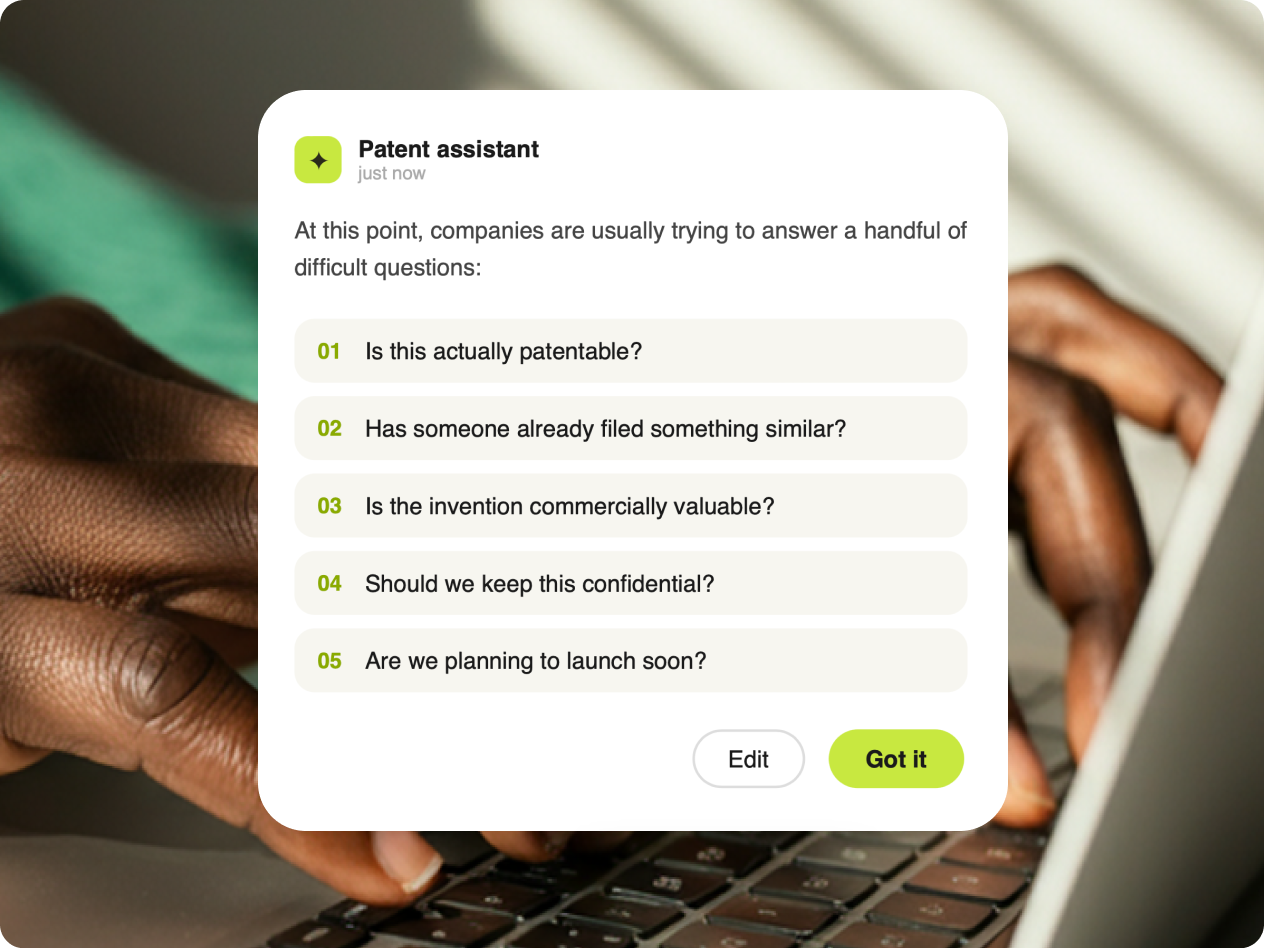
Every patent begins with an invention—such as a new technology, process, formulation, system, or product improvement. At this stage, companies face key questions about protection and strategy.
Timing is critical: publicly disclosing an invention before filing can harm patentability, and details are often unintentionally revealed through investor pitches, demos, conferences, or marketing materials.
Stage 2: Filing the application
Patent pending begins when a patent application is filed with a national or international patent office.
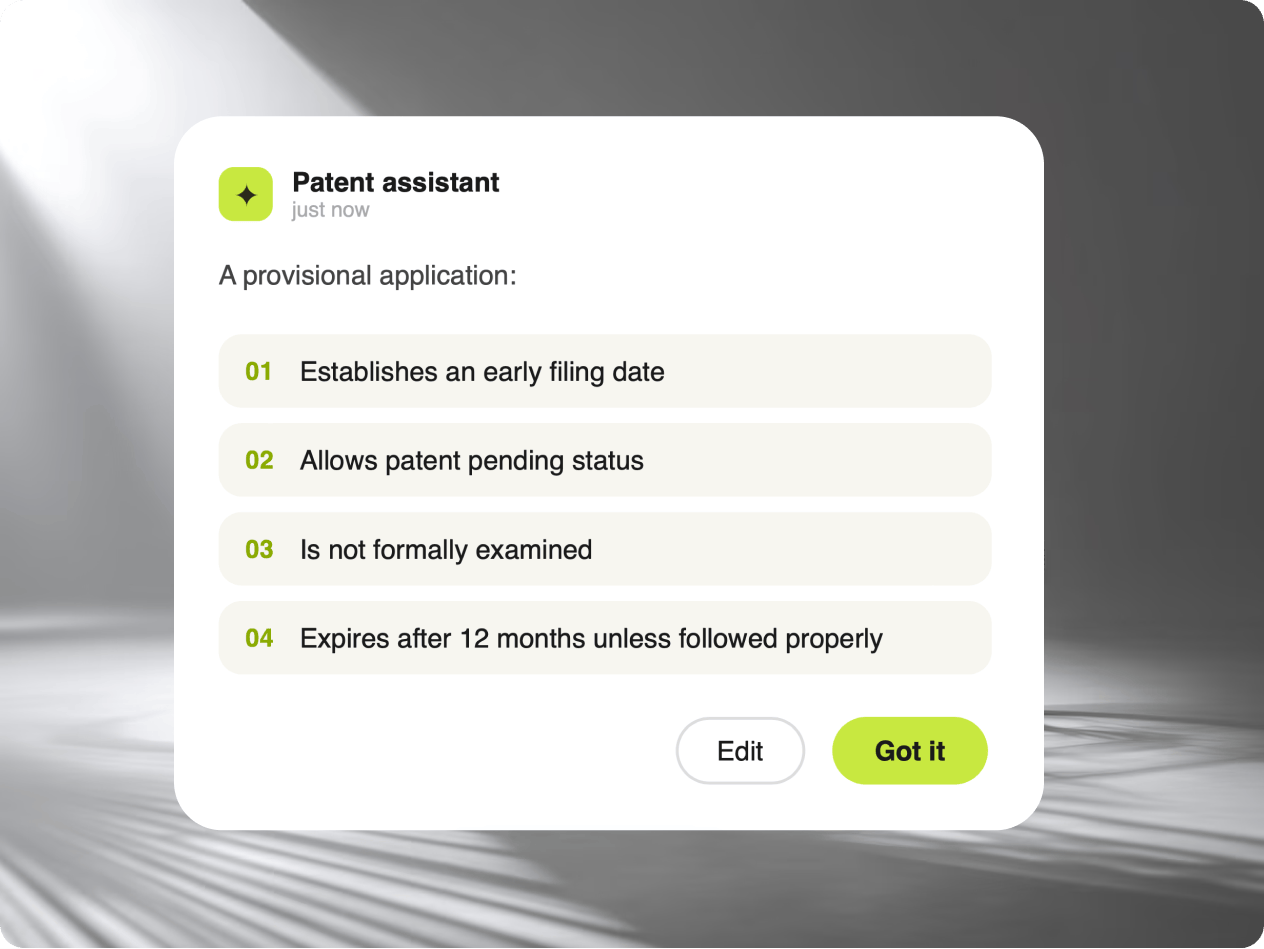
In the U.S., there is no “provisional patent”—only a provisional patent application, which reserves your filing date rather than granting patent rights.
For startups, it can defer costs, but filing quality remains critical, as weak applications can cause problems later.
Stage 3: Publication
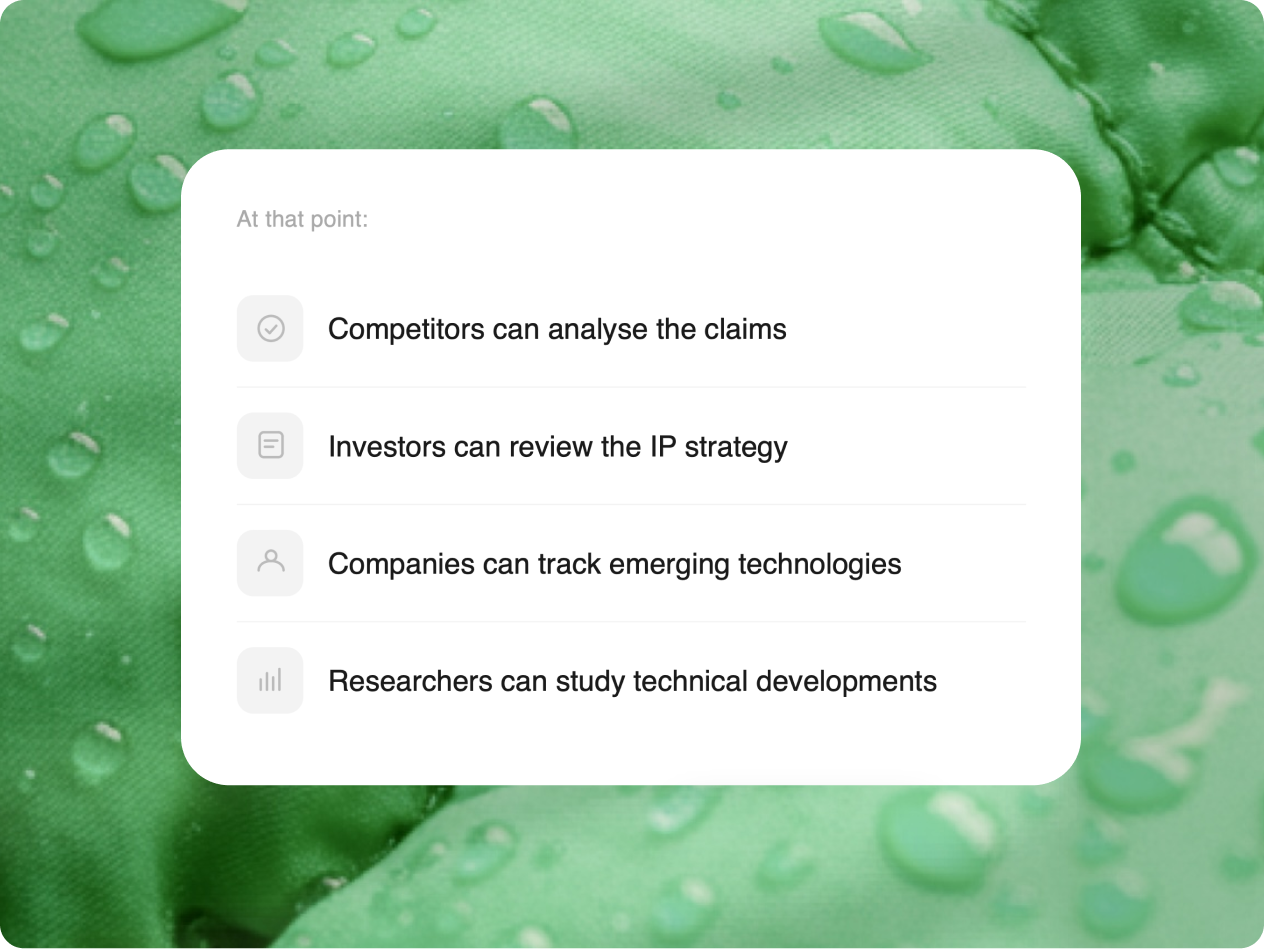
In many jurisdictions, patent applications become public around 18 months after the earliest filing date.
Before publication, competitors may not even know the application exists. Afterwards, the technical details become searchable in public patent databases, which changes the dynamic considerably. In some industries, patent publications effectively become a public roadmap of where the market is heading.
Stage 4: Examination
This is where patent offices determine whether the invention actually deserves protection. Patent examiners review prior art and assess whether the invention is novel and clearly described. The process often involves objections, amendments, and revisions to the claims before a patent can be granted. And it can take years, leaving many companies patent pending longer than expected—especially in software, AI, biotech, and medtech.
Stage 5: Grant, rejection or abandonment
Eventually, the application reaches an outcome. Some patents are granted and become enforceable. Others survive only with heavily narrowed claims. Some are rejected entirely or abandoned because the applicant decides not to continue pursuing protection.
Which is why patent pending should never be interpreted as guaranteed approval. It simply means the process is still ongoing.
Stage 6: Maintenance and expiry
Even after grant, the work doesn’t stop.
Patents require maintenance fees, renewals, jurisdiction management, ownership tracking, and ongoing administration. Miss the wrong deadline and rights can disappear surprisingly quickly.
That’s why patent strategy eventually becomes an operational issue as much as a legal one.
Patent pending vs patented
This is one of the most searched patent questions online because the difference is much larger than many people assume.
Patent pending can still discourage competitors, establish an earlier filing date, support future enforcement, and strengthen investor confidence — even before a patent is formally granted. But it does not create unlimited automatic protection against copying.
Patents matter, but they rarely operate in isolation.
Which is why experienced companies rarely rely on patents alone. Strong businesses usually combine patent protection with other advantages such as speed to market, branding, proprietary data, trade secrets, manufacturing capabilities, or distribution strength.
.1
Describe and upload your innovation
Typically 12 months maximum
Standard utility applications
Commonly 2–5 years or more
Complex international portfolios
Potentially significantly longer
Why patent timelines are getting longer
Modern patent systems are under pressure. Patent offices globally face:
Rising application volumes
Increasingly complex technologies
Software/AI eligibility questions
Cross-border filing growth
As a result, long patent pending periods are becoming more common, especially in software, biotech, medtech, and deep tech sectors. Modern patent systems are under pressure.
Ironically, this means “patent pending” has become a longer-term commercial status than many people expect.
Patent pending internationally
One of the biggest misconceptions about patents is that a single filing creates worldwide protection. It doesn’t. Patents require ongoing maintenance, renewals and administration. Miss a key deadline and rights can be lost. As a result, patent strategy often becomes a balance between cost, market opportunity and enforcement considerations.
There’s another side to this. Using “patent pending” inaccurately can create legal and reputational problems. For example:
Claiming patent pending status without a filed application
Continuing to use the label after abandonment
Misleading customers or investors
In some jurisdictions, false marking laws apply. Which means patent status management matters more than many companies realise.
Patent pending is a stage not the finish line
The phrase can sound final from the outside, but in reality it marks the beginning of a much longer process.
Once an application enters the patent system, everything that follows starts to matter: examination, claim scope, filing strategy, renewals, enforcement, jurisdictions, and commercial execution.
The companies that handle patents well understand that patent status is not just paperwork sitting in a folder somewhere. It’s active business infrastructure that needs ongoing visibility and management.
Absolutely. In fact, most companies do. Many products reach the market long before a patent application finishes examination, especially in industries where product cycles move quickly.
Waiting for full patent grant before launching would slow innovation dramatically. The important thing is understanding that filing strategy, legal enforceability, and commercial readiness rarely move at the same speed.
Does patent pending mean approved?
No. Patent pending does not mean the patent office has approved the invention. It only means an application exists.
The application may still be examined, amended, rejected, abandoned or narrowed significantly.
How long does patent pending last?
It depends on the filing type and jurisdiction.
Provisional applications often last 12 months Standard patent applications may remain pending for several years
The status remains while the application is actively pending.
Can someone copy a patent pending product?
Potentially, yes. Patent pending alone does not automatically stop copying. However, filing early may help establish future rights depending on: Jurisdiction Publication status Eventual granted claims
Does patent pending expire?
Yes. If the application is abandoned, rejected, withdrawn or reaches grant, the “patent pending” status changes.
Trusted by founders. Loved by engineers.
4.8
/5
4.8 out of 5 stars G2 reviews
Jonas
Jonas
Small-Business (50 or fewer emp.)
February 23, 2026
User-Friendly, Cost-Effective Patent Filing
4.5
out of 5
I find Lightbringer very easy to use, which makes my work with patent applications straightforward. The support is good, which makes any issues that come up less of a hassle. I also appreciate the low cost, which is a significant factor for my team...
Michael L
Michael L
CEO and Founder
November 11, 2025
Efficient Patent Filing Speed with Lightbringer
5
out of 5
I love Lightbringer for its speed of execution in filing a patent which saves me significant time and effort. The process clarity is another standout feature, ensuring I understand each step without confusion...
Patrik L.
Patrik L.
CEO
Small-Business (50 or fewer emp.)
May 27, 2025
"A transparent, cost-effective partner for our patent journey"
5
out of 5
They offer not only solid IP expertise, but also a product and platform that gives us full visibility into our engagements – past, present, and upc...
We use essential cookies to make our site work. 🍪 With your consent, we may also use non-essential cookies to improve user experience and analyse website traffic. By clicking “Accept,” you agree to our website's cookie use as described in our Cookie Policy. You can change your cookie settings at any time by clicking “Preferences.”




.webp)