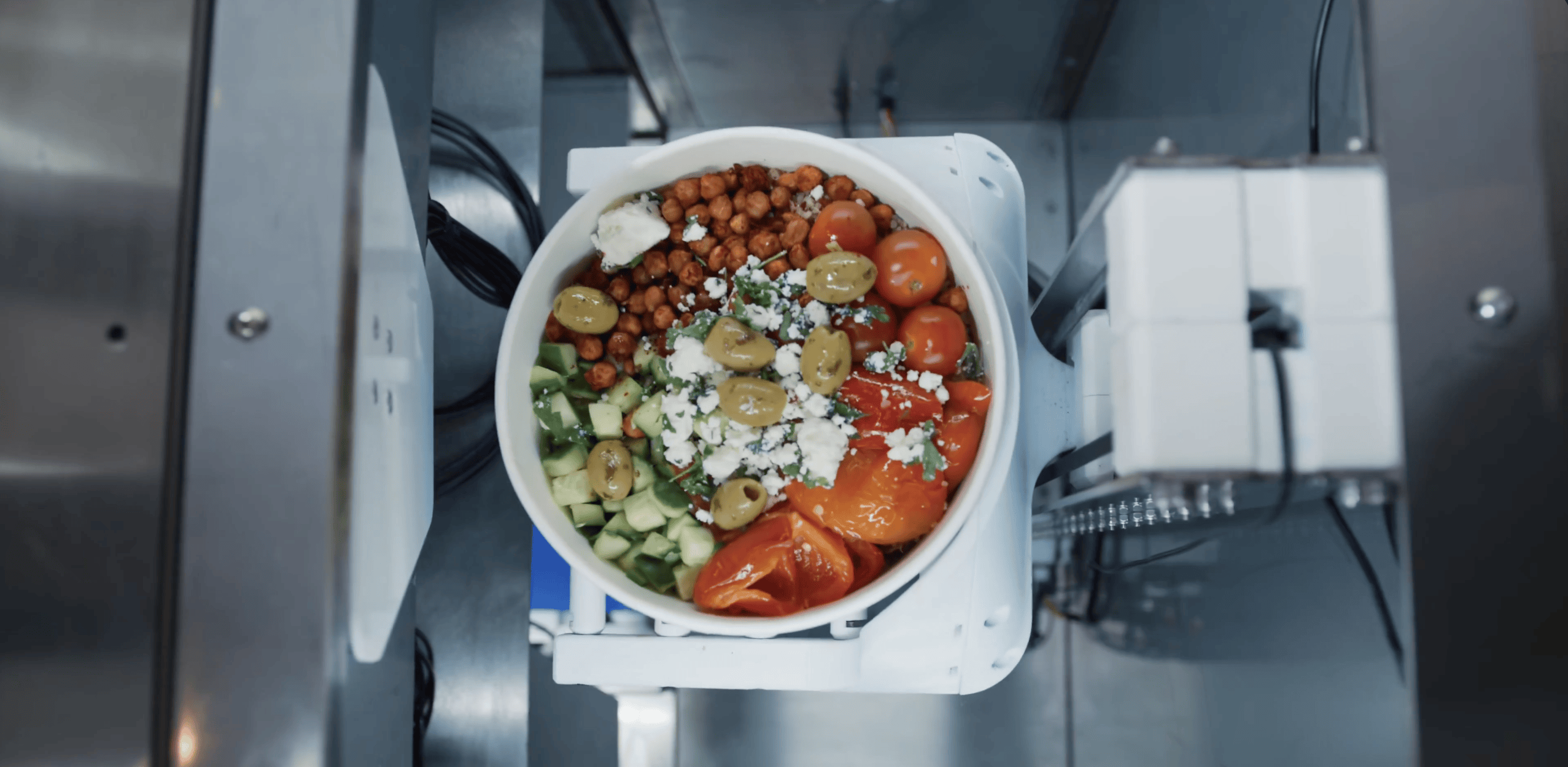
In brief: KAIKAKU, the London robotics startup behind the Fusion food-assembly robot, moved its patent filings to Lightbringer, an AI-native patent platform, after traditional law firms missed a PCT filing deadline and charged recurring invoices for routine emails. Lightbringer filed KAIKAKU's first patent within four weeks of first contact. In 2026, the KAIKAKU team joined REEF Technology, a food-robotics platform backed by more than $1.5 billion in venture funding from SoftBank and Mubadala.
Let's meet the founders of the future
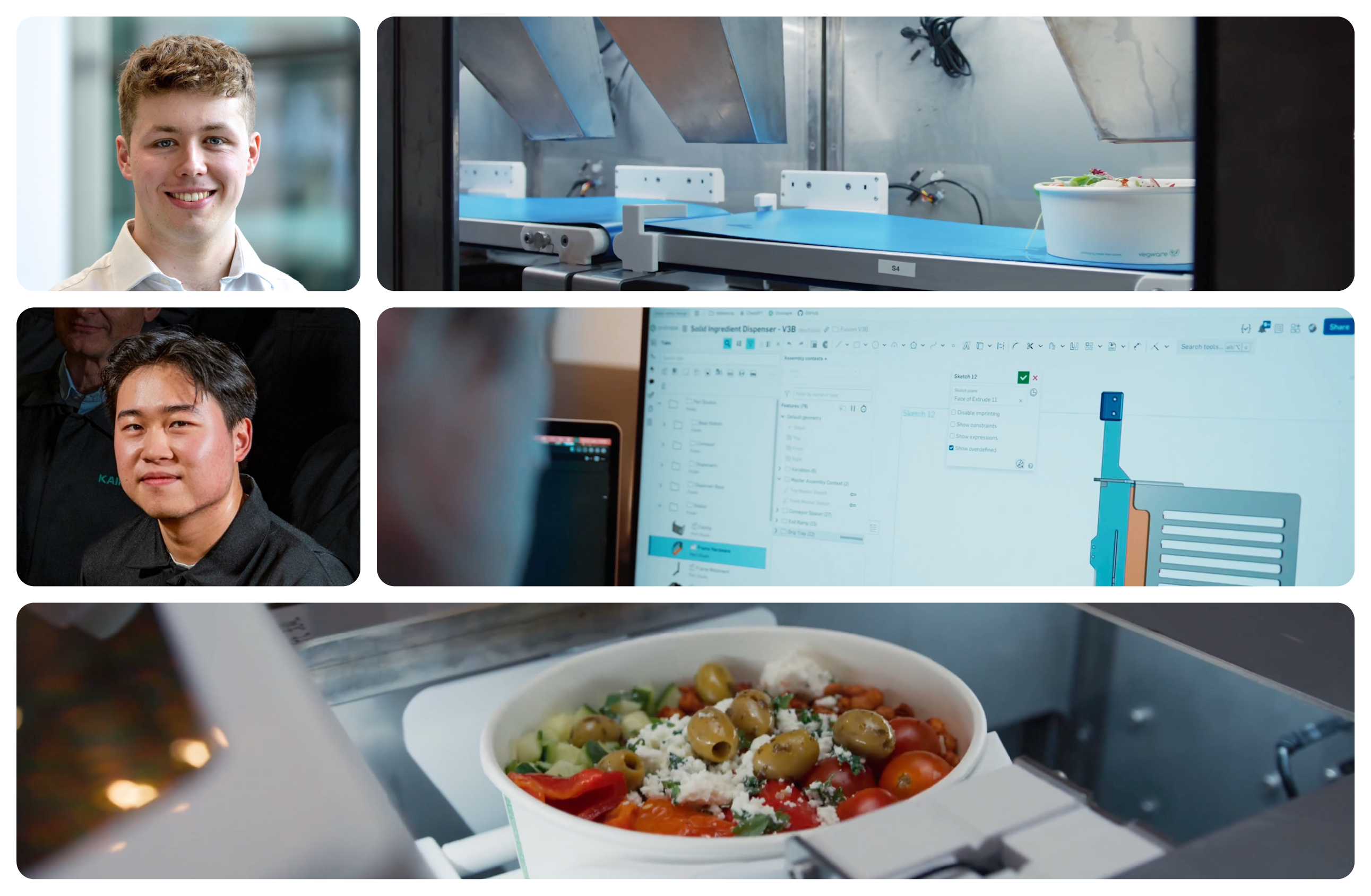
KAIKAKU was a London-based robotics company on a mission to bring automation to an industry that has barely changed in decades. "The restaurant industry is insanely archaic," says co-founder and CTO Ivan Tregear. "We've had robotic arms making cars in factories since the 1970s, and what's considered innovation in the restaurant industry is a McDonald's touchscreen." KAIKAKU had set out to fix that, building a vertically integrated robotics stack, hardware, software, and computer vision, designed to take over the repetitive, hard-to-staff work of a commercial kitchen.
An idea born from an unacceptable gap
Tregear and his co-founders started KAIKAKU straight out of university, convinced that food and beverage was overdue for the kind of automation other industries had taken for granted for fifty years. The restaurant industry, they reasoned, was dealing with chronic labour shortages and a glut of menial tasks nobody wanted to do, an obvious opening for robotics. So they built one. Their flagship product, Fusion, is a food assembly robot that can produce roughly 360 bowls an hour: bowls go in one end, ingredients are dispensed and assembled in the middle, and a finished salad, burrito bowl, or poke bowl comes out the other. The team spent 18 months testing Fusion inside their own restaurant, Common Room, before moving into a B2B motion to get the technology ready for deployment at other sites.
Solving the hardest 5% of the problem
The engineering challenge, Tregear explains, was never moving a bowl from one place to another, that part is easy. The hard part was moving it in a way that stayed clean and avoided mess at speed. About a year and a half into development, the team landed on what they nicknamed the "Core X-Theta" mechanism: a variation on the CoreXY mechanism found in 3D printers, swapping two linear axes for one linear axis and one rotational axis. It was novel enough, and central enough to how Fusion works, that it became one of several patents the team decided to protect. More recently, a pivot toward Traysense, a sensorised, weighing-scale pan system for kitchens that use standard mass sensors on any number of pans, produced another patent, this one filed entirely through Lightbringer.
When the traditional patent process becomes the bigger risk
Before Lightbringer, KAIKAKU had worked with two different traditional patent attorney firms, and Tregear is candid that it wasn't a smooth experience. Poor communication with the first firm led to a missed PCT filing deadline, the company was told the wrong date, which forced KAIKAKU to petition the UK IPO to salvage the application. The second firm communicated better but introduced a different frustration: invoices for routine, no-action-needed emails. "An email would come in and it would just be, 'we've received this communication from the patent office, no action needed.' And then a week later there'd be an invoice for £400," Tregear recalls. "It added up to a lot of small charges."
That experience is exactly why KAIKAKU's early patent strategy for startups looked less like a strategy and more like a reflex. "In university, you get told: whenever you come up with a new idea, get a patent," Tregear says. "I think that's a dangerous philosophy, it's expensive, time-consuming, and it can push you to lock down ideas that don't actually matter."
KAIKAKU's real turning point came from a colder-eyed question: for any given innovation, what is the one specific detail that would actually make it hard to copy? Rather than patenting entire systems, the team now protects that one mechanism or architecture, a sharper, faster way to think about how to patent a robot when engineering time is scarce and a competitor filing first is a genuine risk.
“AI is a tool that when used well, is consistent in a way that a manual process, with all its room for human error, sometimes isn't."
Ivan Tregear
Co-founder and CTO of KAIKAKU
An engineering advisor pointed Tregear toward Lightbringer just as KAIKAKU faced a hard deadline: a patent needed to be filed before a deployment at the end of January, and the team hadn't reached out until mid-December. Lightbringer got the application submitted within four weeks. "The process was really smooth. I could just upload a bunch of files. If there were comments, they didn't have to be £400-invoiced emails, it was just a comment here, a comment there, and I could reply." Five weeks later, with another patent about to need a PCT filing anyway, Tregear moved the rest of KAIKAKU's patent family over to Lightbringer. "It was a pretty quick and easy decision."
Visibility that a black-box process never offered
For Tregear, the biggest day-to-day shift wasn't speed. It was working asynchronously. Declaring an innovation with a traditional firm meant scheduling 60- to 90-minute calls to talk it through in real time. With Lightbringer, he could open an innovation page, dump his thoughts whenever they occurred to him, and let Lightbringer's attorneys reply with questions on their own time. "Making it asynchronous was really nice," he says. He also found he had more visibility into the process than he'd ever had with a traditional firm, where an invention disclosure would disappear into email threads until a draft eventually surfaced. "I could see all of the stages of the patent as it evolved, what I had declared, everyone's comments, the draft, and I like that visibility."
Making it asynchronous was really nice. I could see all of the stages of the patent as it evolved, and I like that visibility."
Ivan Tregear
Co-founder and CTO of KAIKAKU
A quieter kind of return
At the time of this interview, KAIKAKU's journey was leading toward a major milestone, and Tregear was candid that its patents weren't the deciding factor in getting there. "I wouldn't say it was massive, but it certainly wasn't nothing," he says. At an early stage, he sees a patent family less as a direct asset and more as a signal of due diligence done, and of a company that isn't trivially easy to copy. "I can imagine if we were much later stage, it would be much more valuable." It's a grounded, unsentimental way to think about robotics IP strategy: patents as connective tissue between engineering rigour and investor confidence, not a guaranteed payoff.
KAIKAKU's next chapter: joining REEF
That milestone has since arrived. The KAIKAKU team has joined REEF Technology, a food-robotics and logistics platform backed by more than $1.5 billion in venture funding from investors including SoftBank and Mubadala. It caps three years spent deliberately taking on the hardest version of the problem first, rather than chasing a polished demo: five generations of the Fusion robot, a $4 million seed round raised in a category many investors had dismissed as unfashionable, and Common Room growing into one of London's highest-rated bowl restaurants along the way. As KAIKAKU's founders described the move, the goal was never simply to build an impressive robot, it was to prove the technology, the unit economics, and the timing were all ready for scale. REEF now brings that scale.
KAIKAKU worked with Lightbringer's robotics and hardware specialists throughout. Asked whether he'd recommend the traditional patent route or Lightbringer to another founder in his position, Tregear doesn't hesitate: "I would 100% use Lightbringer wherever I could in the future." At Lightbringer, we're glad to have helped KAIKAKU move faster and with more confidence through that journey, and we're looking forward to seeing what the combined KAIKAKU and REEF team builds next.
FAQ
How do you patent a robot or robotics invention?
Rather than trying to protect an entire machine, identify the one mechanism, architecture, or process that would actually be hard for a competitor to copy. KAIKAKU's Core X-Theta mechanism and its Traysense sensor architecture were both examples, and file on that specific innovation. A narrower, well-drafted robotics patent is usually faster and cheaper than one that tries to cover an entire system.
Do early-stage startups need a patent?
Not automatically. KAIKAKU's own experience was that patenting every idea "for the sake of it" wasted time and money on protection that didn't matter commercially. A patent is worth filing when it protects a genuine point of competitive risk, not by default.
What's the difference between first to file and first to invent?
The UK, EU, and US all operate on a first-to-file basis, meaning the patent goes to whoever files first, regardless of who invented it first. For a hardware startup iterating quickly on new mechanisms that makes filing speed, not just the strength of the idea, a real competitive factor.
Does filing a robotics patent actually help with fundraising?
It can, but usually as a signal rather than a hard asset. As Ivan Tregear put it, a patent family at an early stage suggests due diligence has been done and that the technology isn't trivially easy to copy, useful in investor conversations, even if it isn't the deciding factor in a deal.
.png)
.png)

.png)

.png)

.webp)